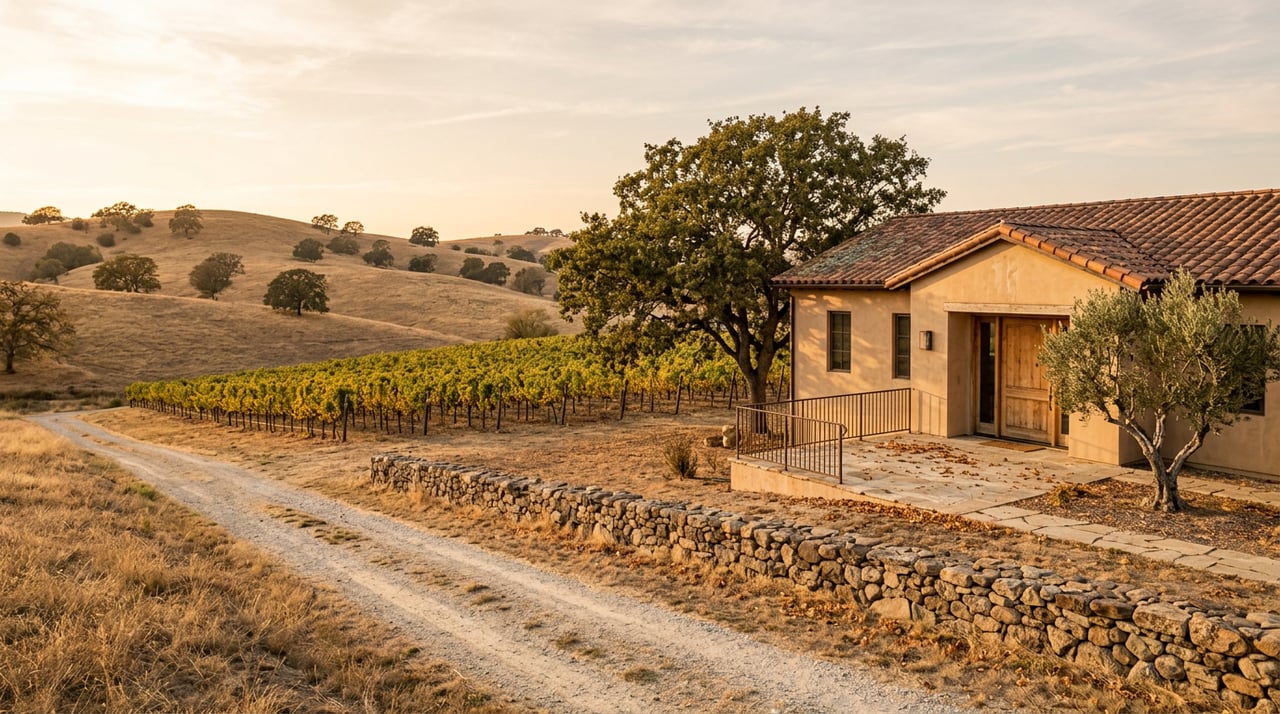
Mark Themig bought his Cloverdale home in 2022 with a plan already written into the purchase agreement. The house had been carved off a vineyard parcel and was still drawing water from the vineyard's well. His contract gave him a deadline: drill a separate well of his own and stop using the vineyard's water by May 2026.
He started the permit process in late 2024, right as Sonoma County's long-running well ordinance fight reached a boiling point. Two of the three drilling companies he contacted told him to file fast, because a court order suspending new well permits looked imminent. It arrived within days. For a while, Themig's contractual deadline and the county's permitting authority were pointed in opposite directions.
His situation is the clearest illustration of what this ruling actually means for people buying, selling, or subdividing rural property in Sonoma County. It is not really about whether the county's well rules are strict enough. It is about timing, and about how a slow-moving legal fight over environmental review can turn an ordinary 60-day escrow into something far less predictable.
The Ruling in Plain Terms
On August 4, 2026, California's First District Court of Appeal issued a split decision in Russian Riverkeeper v. County of Sonoma, the case that has shadowed the county's well permitting program since 2023. Russian Riverkeeper and the California Coastkeeper Alliance had sued to invalidate Sonoma County's amended well ordinance, arguing it failed to protect the Russian River watershed under the public trust doctrine and skirted required environmental review under the California Environmental Quality Act.
The court gave each side part of what it wanted. Associate Justice Tara Desautels wrote that the county had gathered evidence, engaged the public, and reasonably balanced competing interests when it revised its well rules in 2023, so the ordinance itself survives the public trust doctrine challenge. But the same panel agreed with the trial court that the county had never conducted the environmental review CEQA requires before adopting those changes, and it upheld the order voiding the county's claimed CEQA exemptions. The case now goes back to Sonoma County Superior Court, where it has been reassigned to Judge Jane Gaskell following the retirement of Judge Bradford DeMeo, who issued the original 2024 ruling against the county.
"Sonoma County spent years and significant taxpayer money trying to convince the courts that counties have no duty to protect our rivers from excessive groundwater pumping. The Court of Appeal shut that door in a decision that now binds every county in California."
That's Sean Bothwell, executive director of the California Coastkeeper Alliance, reacting to the public trust portion of the ruling. Don McEnhill of Russian Riverkeeper struck a similar note about the CEQA finding, saying the county will now have to support its ordinance with actual evidence rather than assumptions about how well permits affect fish populations in the watershed.
Why Almost No Existing Well Is Actually at Risk
Here is the detail that gets lost in coverage of a court case: Sonoma County's well ordinance was never written to scrutinize every well. It carves out a narrow discretionary review lane and lets everything else through on a ministerial basis, meaning staff approve applications that meet objective construction standards without further evaluation.
That discretionary lane only applies to wells that clear two conditions at once. The well has to draw more than 2 acre-feet of water a year, which works out to roughly 650,000 gallons, far beyond what a typical household uses. And it has to sit inside the county's mapped Public Trust Review Area, a 313-square-mile zone drawn around places where groundwater pumping is understood to affect stream flow for salmon and steelhead in the Russian River, Petaluma River, and Sonoma Creek watersheds.
| Well profile | Review type | Who this typically affects |
|---|---|---|
| Existing residential well, no new construction | No new permit required | Most current homeowners |
| New or replacement well under 2 acre-feet/year | Ministerial, objective standards only | Most single-family home buyers and rebuilds |
| New or replacement well over 2 acre-feet/year, outside the Public Trust Review Area | Ministerial | Larger agricultural or estate parcels outside the mapped zone |
| New well over 2 acre-feet/year, inside the Public Trust Review Area | Discretionary public trust review | High-volume vineyard, ranch, or large-acreage wells in the mapped zone |
By the county's own estimate, somewhere between 5 and 15 permits a year fall into that last, more scrutinized category, out of roughly 280 to 320 well permits issued annually between 2017 and 2022. In court filings, the county acknowledged that about 95 percent of applications remain ministerial. If you already own a home with a working well, this litigation was never coming for it. If you're buying a typical single-family property, your future well work almost certainly clears the ordinary path.
The Russian River Property Owners Association, which sat on the technical committee that helped shape the 2023 amendments, also negotiated specific protections into the rules: baseline water use is preserved for replacement wells, vineyard irrigation gets an allowance of 0.6 acre-feet per acre, and agricultural wells keep their ministerial processing rather than being pushed into a slower discretionary track.
The Freeze Is the Real Risk, Not the Rulebook
So if the substance of the ordinance touches so few properties, why did Mark Themig almost miss his contract deadline? Because the actual danger in this litigation has never been the ordinance's content. It's the county's permitting calendar getting suspended entirely while the courts sort out procedure.
That happened once already. In December 2024, a Superior Court order required Sonoma County to suspend all non-emergency well permitting countywide, regardless of acre-feet or zone, while the environmental review question was litigated. That freeze lasted until the Court of Appeal granted the county a stay in March 2025, allowing Permit Sonoma to resume issuing permits while the appeal played out. Board Chair Lynda Hopkins said at the time that complying with the freeze could mean the county had no ability to issue any non-emergency water well permit while it worked through the required review, a process county officials estimated could take multiple years and cost hundreds of thousands of dollars to complete properly.
That's the mechanism worth understanding if you're under contract right now. The August 2026 ruling sends the case back to Superior Court to determine how the county should complete its CEQA review. Nothing in the current record suggests permitting has stopped again. Permit Sonoma's own September 2026 newsletter makes no mention of a suspension, and the county appears to be issuing permits under the existing 2023 ordinance while it works out its next move. But the case is not resolved. It's remanded, not closed. A property with a straightforward, low-volume well outside the Public Trust Review Area faces essentially no substantive risk from this ordinance. What it can't fully insulate against is a repeat of the December 2024 scenario: a court order that pauses the entire county's queue, unrelated to how modest your own well request happens to be.
What This Means If You're Under Contract Right Now
If your transaction depends on drilling a new well, replacing a failing one, or separating a home from a shared agricultural water source the way Themig's did, a few questions are worth settling before you remove contingencies:
- Ask whether the parcel falls inside the Public Trust Review Area. Permit Sonoma maintains a public well ordinance map that shows this directly.
- Confirm the anticipated groundwater use in acre-feet per year. Most single-family domestic wells fall well under the 2 acre-foot threshold that triggers discretionary review.
- Ask your well contractor or Permit Sonoma directly whether current processing is ministerial or discretionary for your specific application, since that changes the realistic timeline.
- If your purchase agreement includes a hard deadline tied to well completion, build in language for delay caused by regulatory action outside either party's control, particularly if the well will draw from a shared or agricultural source that needs to be separated.
- If you're buying land specifically to build later, ask whether a Vesting Certificate makes sense to lock in current well standards before starting construction.
None of this is legal advice, and anyone with a live contract tied to a well permit should talk to their own attorney about specific deadline language. But knowing where your property sits on this map, before you're deep into escrow, is the difference between a routine permit and a call to your agent asking what happens next.
A Few Questions Worth Asking Early
Does this ruling affect wells that are already in use? No. The litigation concerns the process for approving new or replacement well permits going forward. It does not require existing, previously permitted wells to be re-reviewed.
Could the county appeal further? The Court of Appeal's decision does not appear to have been the final word as of this writing, and the case has been remanded to Superior Court for further proceedings on the environmental review question. Buyers and sellers with time-sensitive well needs should check Permit Sonoma's well ordinance page for current status before finalizing timelines.
Does this affect septic systems too? No. This case is specific to groundwater well permitting under Sonoma County Code Chapter 25B. Septic system permitting runs through a separate program.
Rural Sonoma County properties, from vineyard-adjacent homes in Dry Creek and Alexander Valley to acreage along the Russian River corridor, come with due diligence questions that don't show up on a standard disclosure form. If you're weighing a purchase or sale that involves a well, a parcel split, or a property still tied to someone else's water source, Steve Bowne can help you sort out what actually applies to your situation and what timeline to plan around before you're locked into a contract date.