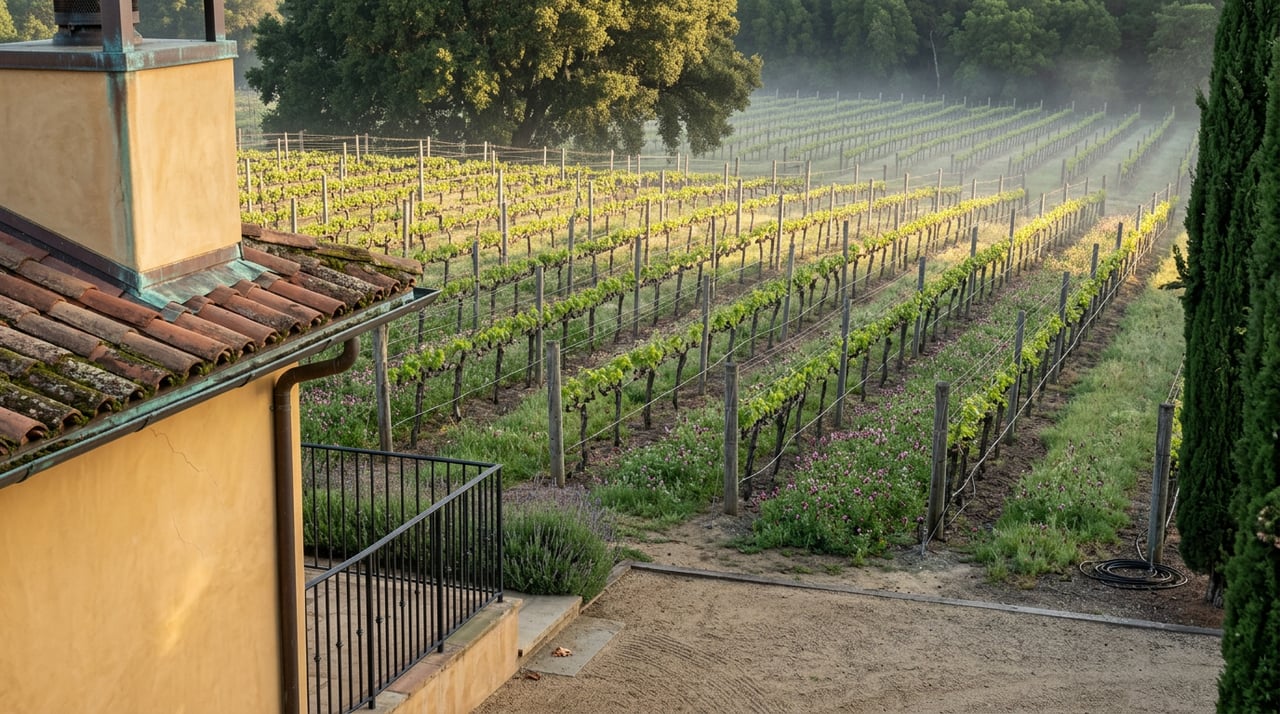
"If you have to sell today, the prices are going to be less than they used to be," said Tony Correia, a Sonoma-based agricultural land appraiser, speaking at a wine industry conference in Santa Rosa this past May. He was talking about vineyards, not houses. That distinction matters more than most buyers realize when they start looking at wine country property with acreage attached.
Because right now, Sonoma County is running two markets at once, layered on top of each other, on the same parcels. The housing side has stayed tight, with homes still selling briskly and inventory thin across most price points. The vineyard side, the actual planted acreage that sits behind or beside those homes, is five years into a real downturn. If you're shopping for a property with vines, or trying to sell one, treating those two layers as a single number is the mistake that costs people money.
Two Markets Living on the Same Parcel
The wine industry's correction is not a rumor passed around at tasting rooms. Growers pulled roughly 2,700 acres of vines out of Sonoma County ground between October 2024 and August 2025, about 5 percent of the county's planted vineyard, according to a standing acreage report from the California Association of Winegrape Growers and Land IQ. The 2025 grape crush came in at 185,500 tons, down nearly a third from the industry's recent peak, per preliminary USDA figures released in March 2026. The dollar value of that harvest fell right alongside it, from $777 million in 2018 to an estimated $523 million in 2025. Karissa Kruse, president of Sonoma County Winegrowers, put a finer point on it last November: roughly 30 percent of local grapes went unsold in 2025.
None of that shows up in a county-wide home price chart, because it isn't supposed to. A house holds value differently than a crop does. But if the parcel you're evaluating includes planted acreage, that acreage is carrying its own separate economics, and those economics are under real pressure.
"We think we'll stabilize, but it's not this year." "I personally think that the horizon starts to look better in 2028."
That's Mario Zepponi, managing director of BMO Capital Markets' beverage alcohol team, at the same May conference, describing a recovery that won't be quick and won't look like the last one.
Why the Median Price Never Mentions the Vines
Part of why this gap is easy to miss is structural. Under California's property tax rules, permanent plantings like vineyards get assessed as real property in their own right, separate from the house and the land underneath it. Vineyards under a Williamson Act contract get an even more distinct treatment: a restricted, income-based valuation rather than a straight market comparison. That income approach is exactly where the correction is showing up first.
The Sonoma County Assessor's office confirmed this year that it added a risk component to its income-based valuation for Williamson Act vineyard properties, citing "uncertainty and decline in grape income." In plain terms, the county itself is now formally pricing in the possibility that a vineyard won't earn what it used to, even while the house sitting on that same parcel is assessed under ordinary Proposition 13 rules that have nothing to do with grape prices.
Here's what that split looks like when you set the two layers side by side:
| Signal | Residential layer | Vineyard layer |
|---|---|---|
| Recent trend | Homes have kept selling near or above list price with tight inventory across the county | About 2,700 acres, roughly 5% of planted vineyard, came out between October 2024 and August 2025 |
| 2025 snapshot | Demand held up across most price points | Crush fell to 185,500 tons; harvest value dropped to an estimated $523 million from $777 million in 2018 |
| Who's saying it | Ongoing county listing activity | Karissa Kruse, Sonoma County Winegrowers: about 30% of local grapes went unsold in 2025 |
| Assessor's response | Standard Prop 13 factored base-year treatment | Added a formal risk component to 2026 Williamson Act valuations |
The Appraisal Gap That Can Blindside a Buyer
There's a second wrinkle that catches even experienced buyers off guard. Grape prices reported in industry averages often reflect long-term contracts negotiated years earlier, many of which include built-in annual increases. That means the "average price per ton" a seller or an appraiser cites may not reflect what a new contract would actually pay today. North Coast grape broker Christian Klier of Turrentine Brokerage has said publicly that district averages could lag the real market by about two years before they catch up to current pricing for varietals like Sonoma County Pinot Noir.
Practically, that means a pro forma built on last year's district average can overstate what a vineyard block is worth right now. Before you treat vineyard income as part of the purchase price, ask a few pointed questions:
- What is the actual per-ton price in the current or most recent grape contract, and when does that contract expire?
- Is that price close to what growers with the same varietal are getting on new contracts today, or is it riding an older agreement?
- Is any part of the parcel under a Williamson Act contract, and does this year's restricted assessment already reflect the county's new risk adjustment?
- If the existing lease or contract lapses, is there a buyer for that fruit at all, given that roughly a third of the county's grapes went unsold in 2025?
What Changes Once VESCO Loosens Up
There's a policy shift working through the county right now that could reshape how these properties get used going forward. On August 18, 2026, the Sonoma County Board of Supervisors voted unanimously to advance changes to the county's 26-year-old Vineyard Erosion and Sediment Control Ordinance, known as VESCO, first adopted in 2000. The revision would create an easier permitting path for growers to swap out one crop for another, including winegrapes, as long as the cultivated footprint stays the same. A second, final vote is expected in September 2026 before the change takes effect.
Mike Martini, speaking on behalf of the Sonoma Alliance for Vineyards and the Environment, and Dayna Ghirardelli of the Sonoma County Farm Bureau both welcomed the move as a way to keep struggling ag land economically usable rather than abandoned in the ground. On the environmental side, Don McEnhill of Russian Riverkeeper said his organization hasn't observed water quality problems since growers began pulling vines in the county last summer, which is part of why the board's discussion moved through with relatively little pushback.
For a buyer, this matters beyond policy trivia. A vineyard block that isn't earning its keep has historically been expensive and slow to convert, tangled in permitting and public notice requirements. Once the revised ordinance is adopted, swapping that block for an orchard, pasture, or another crop should get meaningfully simpler. A property with underperforming vines might be less of a liability than it looks on paper, provided you go in with eyes open about the timeline and the current rules.
How to Read a Vineyard-Anchored Property Right Now
- Price the home and the vineyard as two separate things, and ask your agent to pull comps for each layer independently rather than one blended number.
- Get the actual grape contract or lease in hand, not just the assessor's classification of the acreage as vineyard.
- Compare the contracted price per ton against what current spot contracts for that varietal are paying in the area.
- Confirm whether the parcel carries a Williamson Act contract and whether the 2026 assessment already reflects the county's added risk component.
- If the vines are underperforming, ask what a VESCO permit for a crop swap would involve, and track the board's second vote expected in September 2026.
A Few Questions Worth Asking Before You Write an Offer
Does having a vineyard automatically raise a Sonoma County home's price? Not the way it used to. The house and the surrounding land can still carry strong value in a tight county-wide market, but the vineyard itself is a separate, currently strained asset. Treat it as its own line item, not a built-in premium.
Will my property taxes go up because the parcel includes vineyard acreage? Not necessarily. Land under a Williamson Act contract is assessed on a restricted, income-based approach, and the county's own risk adjustment for 2026 points toward lower assessed values for many vineyard properties this year, not higher ones.
Does this mean wine country is a bad place to buy right now? No. It means the ag layer and the residential layer need to be evaluated separately. Plenty of buyers want a property for the setting, the privacy, and the lifestyle rather than the grape income, and for them, a softer vineyard market can be an opening rather than a warning sign.
None of this is a reason to avoid vineyard-adjacent property in Sonoma County. It's a reason to look at the two halves of the deal with the right lens on each one, rather than assuming the vines add value simply because they're there. If you're weighing a property with acreage anywhere from Sonoma County's river towns to its inland valleys, and you want someone who will walk the crop contract and the comps with equal attention, Steve Bowne has spent his career in exactly this kind of terrain. Let's Connect before you write an offer that prices the vines like it's still 2019.